



INDIANAPOLIS (WRTV) — Gov. Mike Braun on Tuesday said having a designated military police response force will help rather than hurt public safety.
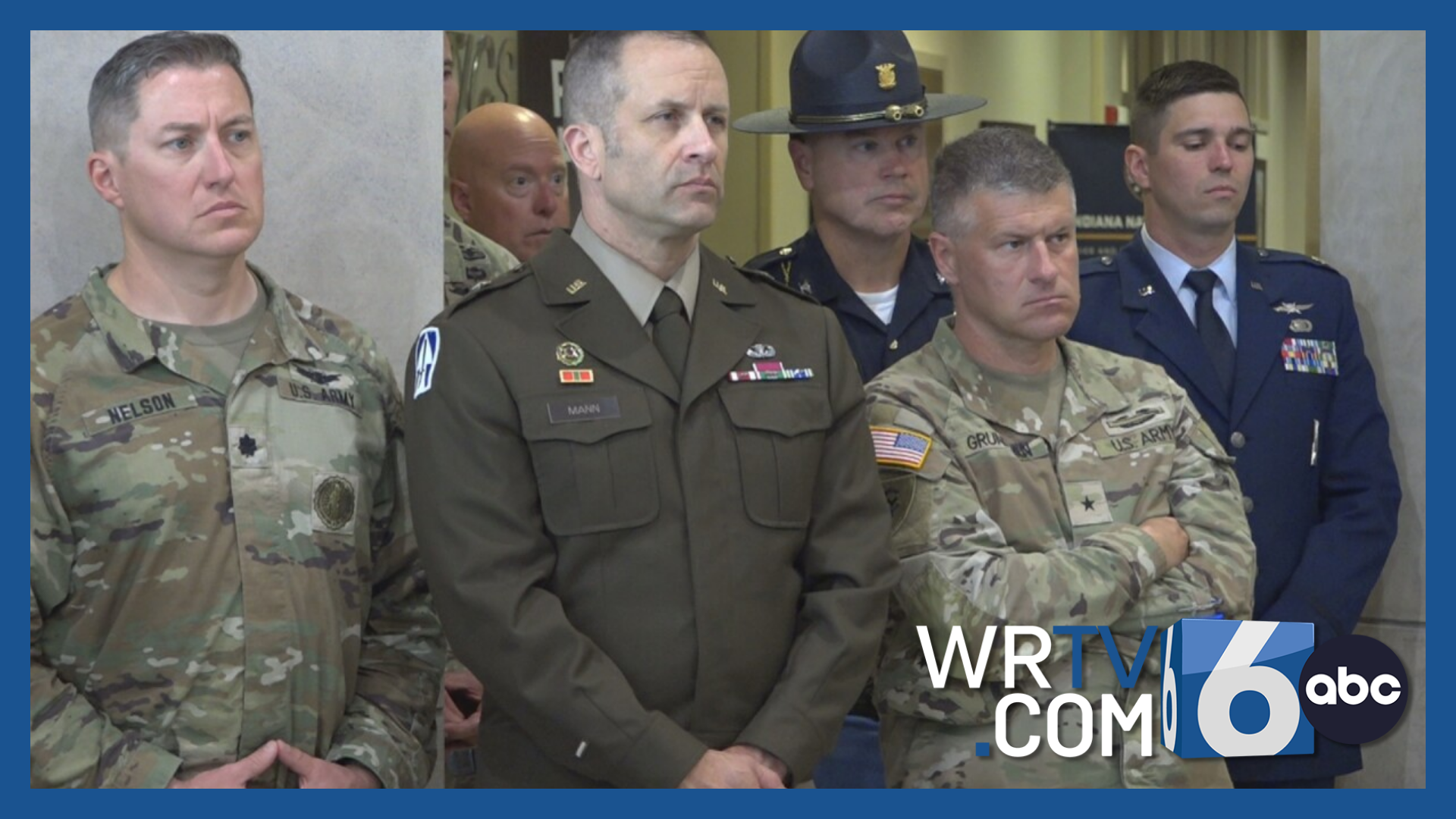
The governor's remarks came at a signing ceremony for the new law creating a designated military police response force within the Indiana National Guard, which the governor can call out for any situation in which he believes civilian agencies have become overwhelmed.
The force is limited to National Guard personnel who are classified as Army military police or Air Force security forces. Those are specific law enforcement roles within the armed forces for which enlistees receive specialized training.
The new law requires those personnel to first undergo a training course specific to Indiana law enforcement.
Indiana State Police Superintendent Anthony Scott on Tuesday said the first 40 National Guard personnel had completed the training, and a second group of 40 will begin their training in July. He said their training includes autism awareness, mental illness and legal considerations. Those personnel have the authority, when activated, to make arrests, carry a firearm and search and seize property.
In an exclusive interview with WRTV, Braun said he will use the new unit anytime he believes conditions require it. He cited recent instances where he called in state police to back up IMPD after a violent Independence Day weekend last year and to provide additional security for the WNBA All-Star Game.
"To me, this is a smart bill because this is not (the Guard's) normal training, and if you need the extra training, there you go," he said.
The governor has long had the ability to activate the National Guard in response to crises.
Legislative Democrats, however, warned the creation of a specific military police force with a civilian mission erodes the longstanding doctrine of not using military assets for civilian law enforcement purposes.
Rep. Matt Pierce, D-Bloomington, who serves on the House Courts and Criminal Code Committee, said military and civilian law enforcement are not identical because the military has its own set of laws military police enforce, the Uniform Code of Military Justice. He said a workshop on Indiana law enforcement is not the same as going through the entire curriculum required by state law at one of the state's law enforcement academies.
In addition, he said state law allows the governor to deploy the Guard whenever he feels it's necessary, and he believes that could open the door to deployments similar to those ordered by President Donald Trump in cities such as Washington, D.C.
"What you're opening up in Indiana is for a governor who may not like a particular mayor or some local officials or county commissioners, to go ahead and deploy the military police," he said. "If they don't like the way law enforcement is being handled in Indianapolis, the governor, if he feels it's necessary, and the governor alone, can deploy military police into an urban community, and there's no requirement that the local officials actually ask for that help."
Pierce said he would like the legislature to amend the law next year to require a formal request from local officials before the governor deploys the force. Braun and the law's author, Rep. Steve Bartels, R-Eckerty, said the Guard would already have to coordinate with local law enforcement to carry out its mission, so those conversations would happen as a matter of course.
