

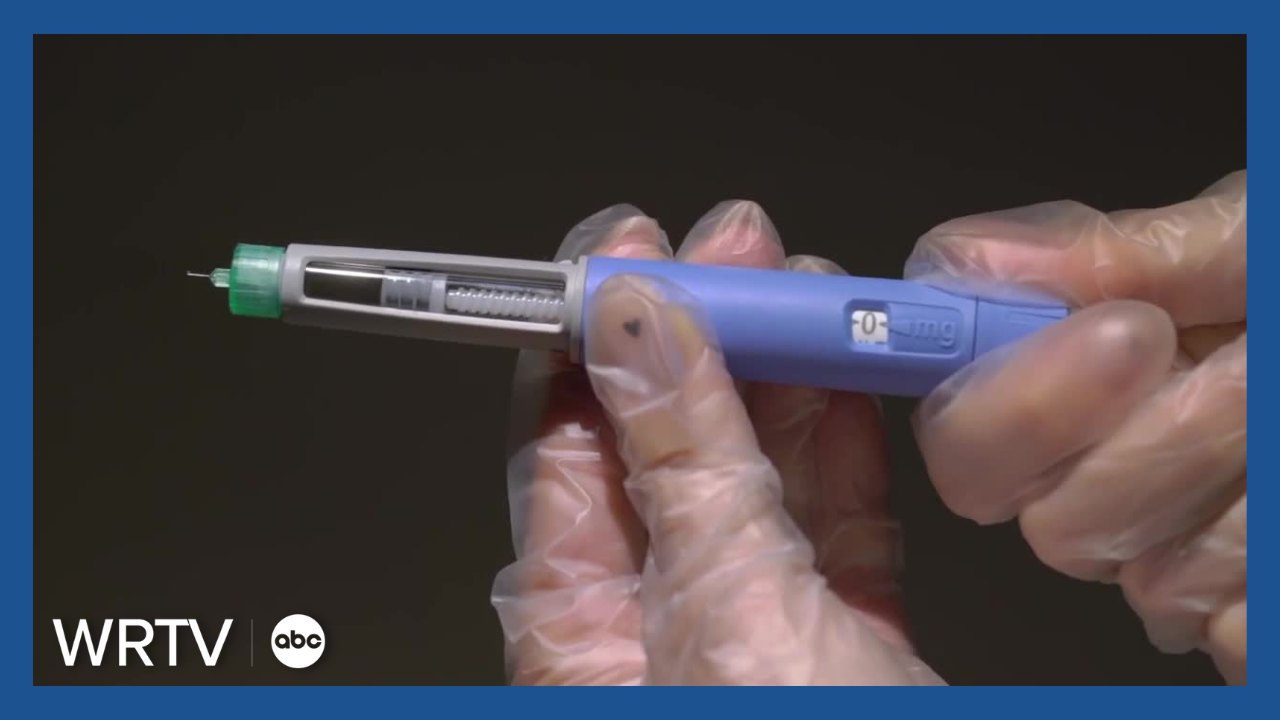


INDIANAPOLIS — For many people, a new year means making resolutions, including losing weight.
One in eight adults says they’ve tried a GLP-1 at some point, according to health policy research organization KFF.
GLP-1s are a class of medications, often injectables, first introduced in 2005 to treat diabetes.

They are now used for weight loss and to manage diabetes, heart disease, and other conditions.
In a week-long series, WRTV Investigates is digging into the benefits and costs associated with these medications.
Patients can pay more than $1,300 a month for GLP-1 drugs, before insurance, rebates or coupons.
A new poll from KFF found more than half (56%) of GLP-1 users say the drugs are difficult to afford, including one in four who say they are “very difficult” to pay for.
In fact, users cite cost as one of the top reasons why they stop taking the medication.
Sue Seyfert lives in Dana, Indiana.
She considers herself lucky to get her Ozempic at no cost to her.
“I go through the VA because my husband is a veteran, and God bless them, I don’t have to pay anything,” said Seyfert.
Sue says taking Ozempic is not about dropping pounds.
She has Type 1 diabetes and uses GLP-1s to help regulate her blood sugar.
“It would be a game changer for me,” said Sue. “It is all the rage and it is kind of crazy. So many people are on it to lose weight."

Sue said the drug's popularity has made it difficult to find at times.
“The only time I didn’t really like when people were taking it to lose weight is when I couldn’t get it and I’m the one that needed it,” said Sue.
The popularity of GLP-1s is surging.
A new Gallup survey found 12% of Americans reported taking GLP-1s specifically to lose weight, double the number from February 2024.
The obesity rate dropped to 37% of U.S. adults in 2025, down from a high of 40% three years ago, according to the survey.
Meanwhile, Walmart and Costco recently announced new discounted pricing for GLP-1s, and the Trump administration introduced a deal with drugmakers Eli Lilly and Novo Nordisk to lower prices and expand coverage for their GLP-1 medications Zepbound and Wegovy, widely used for weight loss.
RELATED | Trump announces deal to cut price of popular weight loss drugs
“Incredibly effective”: Butler University pharmacy professor explains
GLP-1s have been around for more than 20 years.
The U.S. Food and Drug Administration (FDA) approved the first GLP-1, Byetta, in 2005.
Ozempic received FDA approval in 2017.
It wasn’t until 2021 and 2023 that the FDA approved Wegovy and Zepbound for weight management.
Andy Schmelz, an associate professor of pharmacy practice at Butler University, explained how GLP-1s work.
"It helps to regulate your appetite,” said Andy Schmelz, an associate professor of pharmacy practice at Butler University. “These medications actually mimic the same GLP-1 that your body normally makes, which tells your body that you are no longer hungry."

While the drugs are expensive, they are also very helpful in treating a number of health conditions, said Schmelz.
“These drugs are incredibly effective for weight loss,” said Schmelz. “They're literally the most effective treatment for obesity that we have today."
Tuesday on WRTV News at 6 pm, WRTV Investigates digs into the side effects related to GLP-1s and lawsuits filed regarding the medications.
