




INDIANAPOLIS — A new study shows people carrying medical debt are significantly more likely to have trouble paying their rent or mortgage.
About 6% of Americans owe more than $1,000 in medical debt, but even small medical bills can have a huge impact on your ability to stay afloat and pay other expenses like housing.
Lorrel Lyn-Cook, a Beech Grove mother of two, says her struggle with medical bills started with the birth of her first child.

“It was by c-section, and I think they billed me close to $16,000,” said Lyn-Cook. It was traumatizing. I just had my child, and now I have this huge debt that I didn’t anticipate."
Lyn-Cook reached a settlement with the hospital and paid half of it.
But she had more bills after years of taking care of her sick father.
"I was his caregiver, his advocate, his dietician, the person who handles the finances,” said Lyn-Cook.
Lyn-Cook said she had to pay her dad’s medical bills on top of her credit card debt.
“It was a lot,” said Lyn-Cook. "I already had debt, and so to add this on top of it, I don’t want to be piled on with more debt that I didn’t take on myself."
As a result of her debt, Lyn-Cook has struggled to pay regular bills.
“I bring my own lunch,” said Lyn-Cook. “You do all the right things. You're going to work, you're budgeting.”
Americans owe a total of $220 billion in medical debt, according to the national nonprofit KFF.
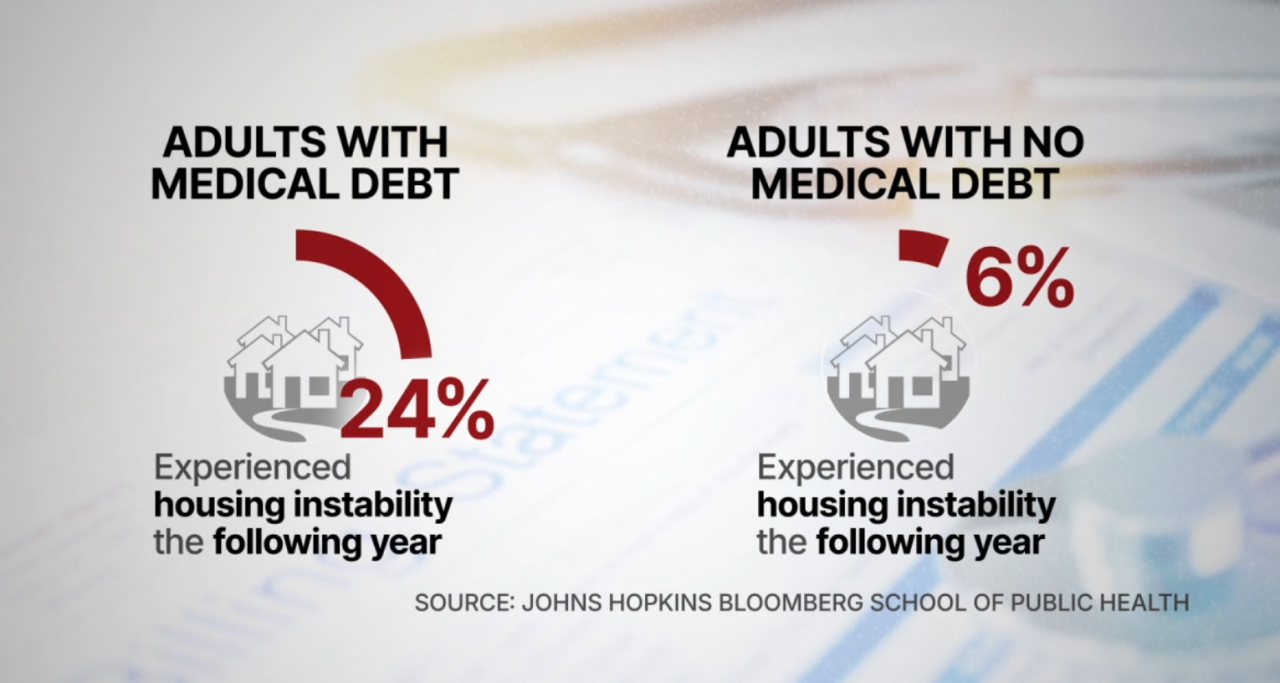
A new study from Johns Hopkins Bloomberg School of Public Health shows 24% of adults with healthcare debt experienced housing instability the following year, compared to just 6% of people who had no medical debt.
"Most Americans do not have enough savings to cover even a small surprise medical bill,” said Thomas Nitzsche, VP at Money Management International, a national nonprofit that helps people get out of debt.
“About 1 in 5 clients say medical debt was the primary reason for them to seek financial counseling,” said Nitzsche. “That’s a significant number."
Experts cite many reasons for the increasing burden of medical debt, including the rising cost of medical services and medicine, inadequate health insurance, and high-deductible plans.
"The medical industry is one of the only industries where surprise billing is the norm,” said Nitzsche. “You don’t really get a written estimate when you seek medical care."

Nitzsche said when clients first start a debt management plan, accounts will close, which typically means a slight short-term dip in their credit score.
“Long term, our average client credit score increase is 82 points from start to finish on the program, which averages four years,” said Nitzsche.
MMI recommends getting help immediately, rather than waiting for the debt to snowball.
Lorrel Lyn-Cook has the same advice.

“Look at it. See what it is,” said Lyn-Cook. “Add it up and get some help."
Lyn-Cook came to Money Management International with $25,000 of debt.
They helped reduce her interest rates and she’s now on track to be debt free by 2028.
“I'm finally gonna go out to eat somewhere nice!” said Lyn-Cook.
According to the Indiana Action Poverty Institute, nearly one in five Hoosiers has some form of medical debt in collections.
Two pieces of legislation focused on addressing medical debt, Senate Bill 85 and Senate Bill 197, died in the Indiana House of Representatives in February.
SB 85 would have prevented a lien on a family's home due to medical debt, created affordable payment plans for hospital debt, required a pause on billing during insurance denial appeals, ensured that people received information on financial assistance options, and protected more of an individual's wages from garnishment.

SB 197 would have protected more of a worker's paycheck when pursued for an overdue debt, and would have protected up to $1500 in a bank account from debt collection attempts.
"For several years now, we have brought the growing crisis of medical debt to lawmakers' attention and asked them to take steps to protect patients and their families. It is incredibly disappointing to see these two meaningful pieces of legislation die after passage in the Indiana Senate," said Erin Macey, Director of the Indiana Community Action Poverty Institute. "We all want the ability to get health care without drowning in medical debt; right now, unaffordable bills and aggressive collection methods like wage garnishment can cause a family's financial downward spiral. It's hard to understand why policymakers chose not to act."
TIPS FROM CONSUMER FINANCIAL PROTECTION BUREAU
Request a detailed list of charges
Ask your healthcare provider or the debt collector for an itemized bill, sometimes called a “superbill.” A superbill shows each medical billing procedure code, the amount paid by your insurance, and the amount you owe. The list makes it easier to tell whether the charges are accurate.
Negotiate the amount you owe
Debt collectors might not tell you that medical charges can be negotiated. You can start by going back to the healthcare provider and asking for reductions. Then, you can talk to the debt collector and ask how to lower the amount you owe.
Submit a complaint
Debt collectors must comply with federal law. They can’t collect amounts that aren’t owed and they can’t make harassing or abusive calls. They have to follow requirements about reporting debts to consumer reporting companies. They can’t call you around the clock, and you have the right to tell them to stop contacting you. See more about your debt collection rights and protections.
You can submit a complaint about a problem with a financial product or service, including debt collection, at consumerfinance.gov/complaint or by calling (855) 411-CFPB (2372).
Get legal help
You can sue debt collectors when they violate federal law. Talk with a lawyer about a medical charge you believe is illegal or a debt collector you believe is breaking the law. Your local legal aid agency or bar association has information about lawyers who can help you. See tips for finding an attorney in your state.

