
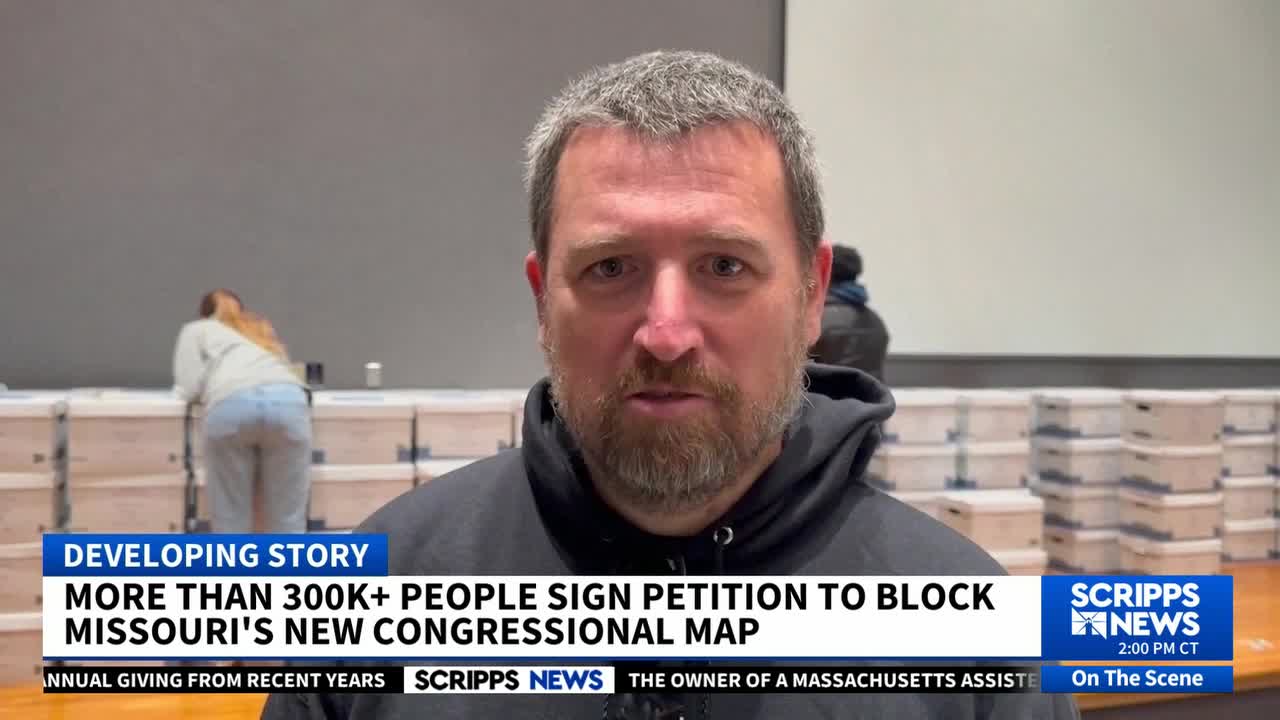


Congressional Republicans’ hopes of retaining control of the U.S. House of Representatives was dealt another blow on Tuesday as voters and voting rights advocates in Missouri submitted what they say are enough signatures to force a vote on newly-approved congressional maps that benefit Republicans.
Moreover, the advocates say, the mere submission of those signatures is enough to halt the implementation of the new maps until voters weigh in on the issue, unless the Secretary of State determines that the petition process was improper or the signatures invalid.
“It is very clear in law and in practice in Missouri that upon the submission of signatures, until the Secretary of State makes a decision to either certify the initiative as sufficient or to certify the petition is insufficient, the map is frozen,” said Richard von Glahn, executive director of “People Not Politicians," the lead group behind the anti-gerrymandering effort.
“As of today, right now, House Bill One is suspended pending voter approval,” von Glahn concluded.
The development is just the latest in an ongoing, national debate over mid-decade redistricting, spurred by President Donald Trump’s forceful call to Republican state officials throughout the country to approve new maps favorable to the GOP ahead of the 2026 midterms.
In September, after hearing from Trump during a caucus meeting, Missouri lawmakers took up the charge and approved a new map that split up the 5th Congressional District, currently held by Democrat Emanuel Cleaver of Kansas City. Should the map be allowed to take effect before next year’s general election, the district would be cut into pieces, likely diluting Democratic voters enough to flip the seat Republican.
But whether the new map can stand — and if Missouri voters will have a say — remains an open question.
MORE ON REDISTRICTING | Supreme Court allows Texas' new electoral maps to go into effect for midterm elections
A legal back-and-forth
The advocates’ move delivering petition signatures follows a court ruling on Monday rejecting an effort by Missouri Secretary of State Denny Hoskins, Attorney General Catherine Hanaway and other state leaders to prevent the referendum from reaching Missouri voters in the first place.
In a legal complaint filed Oct. 15, the state leaders contended that allowing such a referendum would “invite chaos — driven by out-of-state special interests looking to gain a partisan advantage in Congress.” They argued the advocates’ referendum violated both the U.S. and Missouri Constitutions, seeking to block PNP from pursuing the referendum.
Yet after months of legal arguments, Judge Zachary Bluestone of the Eastern District of Missouri dismissed the case, finding he lacked jurisdiction to adjudicate the issue as the lawsuit was filed before the state suffered any supposed harms from the referendum.
“Plaintiff Denny Hoskins has the authority as Secretary of State to reject their petition as unconstitutional during post-submission review and to defend that decision based on the very same constitutional arguments the State advances in this case,” Bluestone wrote.
Reached via email Tuesday afternoon, Rachael Dunn, a spokesperson for the Secretary of State, confirmed Hoskins’ office received “691 boxes [of] signatures related to the redistricting referendum,” and noted officials now have two weeks to “scan, count, and sort signatures prior to distributing to local election authorities for verification of each signature.”
Dunn declined to say whether the Secretary agreed that the newly-gerrymandered maps were currently frozen, deferring to the Missouri Attorney General.
Isabelle Bryson, a spokesperson for Attorney General Hanaway, subsequently told Scripps News in an email that the Attorney General “looks forward to an orderly review process to determine whether the proposed referendum can qualify for a vote.”
“Nothing in the Court’s holding prevents the State from re-filing its suit if and when the proposed referendum qualifies for a vote,” Bryson concluded.
Asked specifically whether the Attorney General agreed with PNP’s position that the maps were currently blocked while the review began, Bryson suggested that might not be the case, though she declined extrapolate.
“The Court also held that the State has not yet suffered any injury because House Bill 1 and the Missouri FIRST Map will go into effect on December 11 and not be frozen unless and until the Secretary of State certifies the referendum,” Bryson wrote. “People Not Politicians agreed in federal court that state law compels this conclusion, and the court based its dismissal ruling on this concession.”
RELATED STORY | Threats and hoaxes target Indiana GOP senators in Trump’s redistricting push
The verification process begins
Meanwhile, as local officials begin their review of the petition signatures, PNP advocates expressed confidence that their referendum push would hold up.
“We need about 107,000 valid signatures for this issue to qualify. We have turned in over 305,000 signatures,” von Glahn told Scripps News. “I am very confident that the that the signatures are sufficient to get this on the ballot.”
But the organization in a statement late Tuesday also suggested it expects state leaders to attempt “procedural delays” and other tactics to block the referendum once again.
“If the Secretary of State refuses to certify the referendum or attempts to put HB1 into effect prematurely, People Not Politicians is prepared to take immediate action in state court,” the group wrote.
Officials said they expected the review to take between 8-10 weeks, though noted it could stretch into summer of 2026.
Hoskins has already stated he intends to challenge any signatures collected before Gov. Mike Kehoe signed the redistricting bill into law on Sept. 29, and indeed previously rejected three efforts by PNP to start the referendum process in earlier September on similar grounds.
Instead, state election leaders have said they will only count signatures collected after Oct. 14, the date Hoskins approved the referendum petition.
PNP has argued all the signatures it collected are valid, but also noted that only around 92,000 signatures were collected before Oct. 14 – leaving well enough to qualify for a referendum without them.
Von Glahn and other anti-gerrymandering advocates have suggested state leaders’ attempt to block the referendum highlights the likelihood that they’ll lose the case, if it moves forward.
“Voters should get the final say,” he told Scripps News. “The proponents of this map, our opponents on this campaign, what they fear the most is the voters ‘verdict, and that is why they continue to take steps to try to avoid a vote from even happening.”
Elizabeth Franklin, a Missourian who helped collect petition signatures, said she found Missourians of all political stripes responsive to PNP’s arguments.
"I think many people in the rural areas just really felt like the Constitution should be followed,” she said. “It was pretty clear that this was not done in accordance with the Constitution, and they wanted to be a part of it.”
