

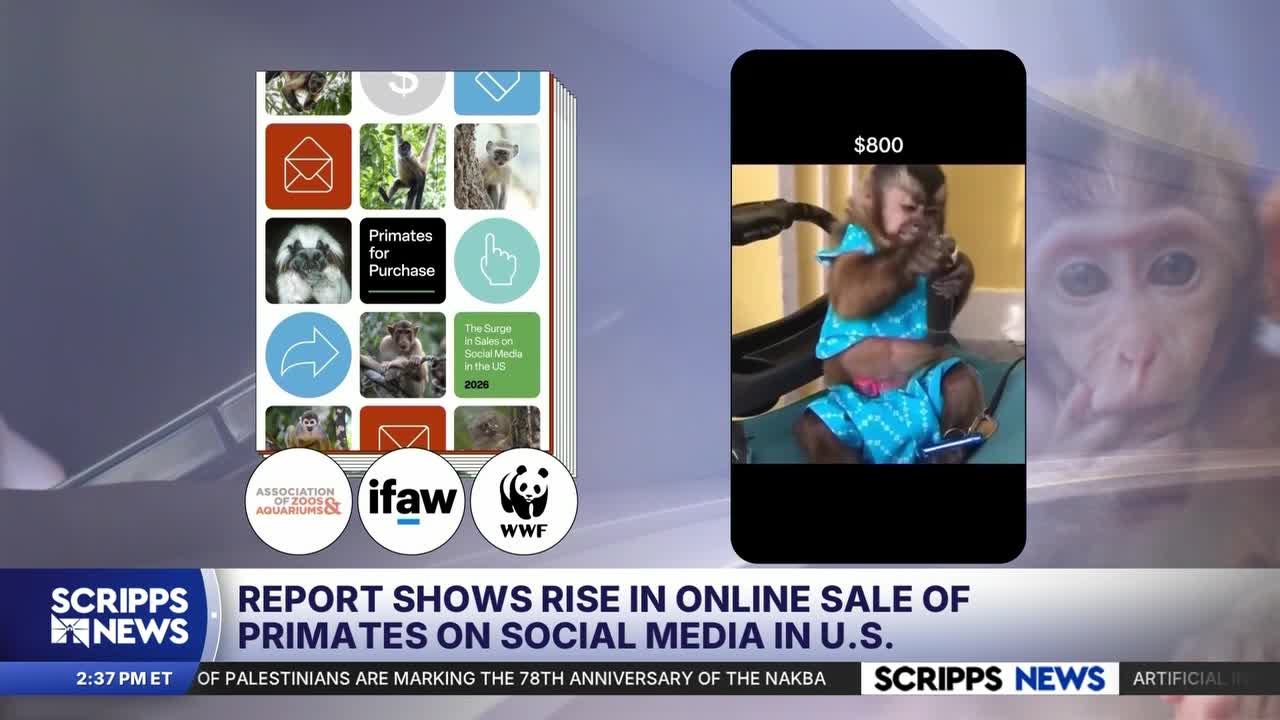



Catchy videos advertising the sale of monkeys and other primates are increasingly spreading across social media putting both wild animals and humans in danger, according to a new report by the World Wildlife Fund and other groups.
“We found this trade was absolutely rampant with more than 1,600 listings found over a six-week period,” said Giavanna Grein, one of the report’s authors and lead specialists at the World Wildlife Fund.
“We're just scratching the surface in what we found here," she said.
The Association of Zoos and Aquariums and the International Fund for Animal Welfare also contributed to the research that found a surge in primates for sale on major social media sites including TikTok, YouTube, Facebook and Instagram.
FROM THE ARCHIVES | WHO Urges An End To Sales of Live Animals At Food Markets
The primates featured in videos included macaques, spider monkeys and chimpanzees. Some are endangered species. Captivity can be fatal for the animals if they are eventually released back into the wild where they naturally belong, Grein said.
"Primates play a critical role in ecosystem health and integrity,” she said. “They are seed dispersers, so they help generate forestry growth. They also play a key role in pollination."
Pet primates are also known to put humans at risk by spreading disease and occasionally becoming aggressive.
The four social media platforms named in the report each have policies aimed at preventing the sale of primates, including by removing content and suspending users. Researchers found the sites took down posts with explicitly commercial language such as “monkey for sale.” Posts with less direct terms like “monkey available” or “for adoption” seemed to slip past filters, the report found.
“It is incredibly easy for anyone to hop on a social media platform and seek to purchase a primate,” Grein said, pointing to a lack of federal and state laws that prohibit the ownership of the animals.
Most states outlaw private ownership of primates, but some states don't require so much as a permit to take home the animals.
“Even the more rigorous state laws are oftentimes not meaningfully enforced,” said Delci Winders, director of the Animal Law and Policy Institute at Vermont Law and Graduate School.
She and the authors of the report want Congress to pass the Captive Primate Safety Act, legislation that would ban the private ownership of primates nationwide.
“There's a real need for federal law,” Winders said. “Most people don't realize it, at the federal level, it is totally legal to own a primate as a so-called pet.”
Rep. Mike Quigley, (D-Ill.), introduced the bill last year, but it hasn't advanced since then.
"We absolutely need to do more to protect them and preserve their wild populations for ecosystem health,” Grein said.
The groups behind this report say online primate sales are just part of a global $23 billion illicit wildlife trade — which is among the top five black markets. They say primates are especially vulnerable because of inconsistent legislation which makes trafficking them a "low-risk, high-reward" criminal enterprise.
IN CASE YOU MISSED IT | New law will shake up the exotic animal industry in the US
YouTube has partnered with the World Wildlife Fund to identify and remove users violating policies against posting content to sell primates.
“We look forward to continuing to partner with WWF on future Cyber Spotter programs and other initiatives to combat this serious issue,” YouTube said in a statement to Scripps News.
Content on Facebook and Instagram featured primates for sale as recently as this week.
Those posts disappeared after Scripps News sent questions about them to Meta, owner of the two platforms.
Meta says it removed the groups and profiles because they violated its policies and said that it continues to invest in tools to detect violating content.
