



June 8 is World Oceans Day — a day officially designated by the United Nations to draw attention to the importance oceans play in our health and the health of the world.
Worldwide, 33 billion pounds of plastic enters the oceans every year. This year, one advocacy organization is drawing attention to the damage one particular type of plastic poses — single-use plastic foam, commonly referred to as Styrofoam.
“Plastic foam is one of the most problematic single-use plastics. It breaks apart really easily. It's really lightweight, and so it travels far and wide, but in the air and in the water too,” said Christy Leavitt, a senior campaign director at Oceana.
When plastic foam breaks down into tiny pieces, animals like sea turtles and birds can end up eating it, causing significant health problems. And microplastic foam has been found in humans too.
“So the building block of plastic foam is styrene. It's a building block for all polystyrene plastics, and polystyrene is classified as a probable carcinogen by the National Institute of Health, which means it probably causes cancer,” Leavitt said. "There are a lot of health impacts of plastic foam, and it shouldn't be something that we are eating and drinking out of."
RELATED STORY | San Francisco has turned to AI to avoid collisions between ships and whales
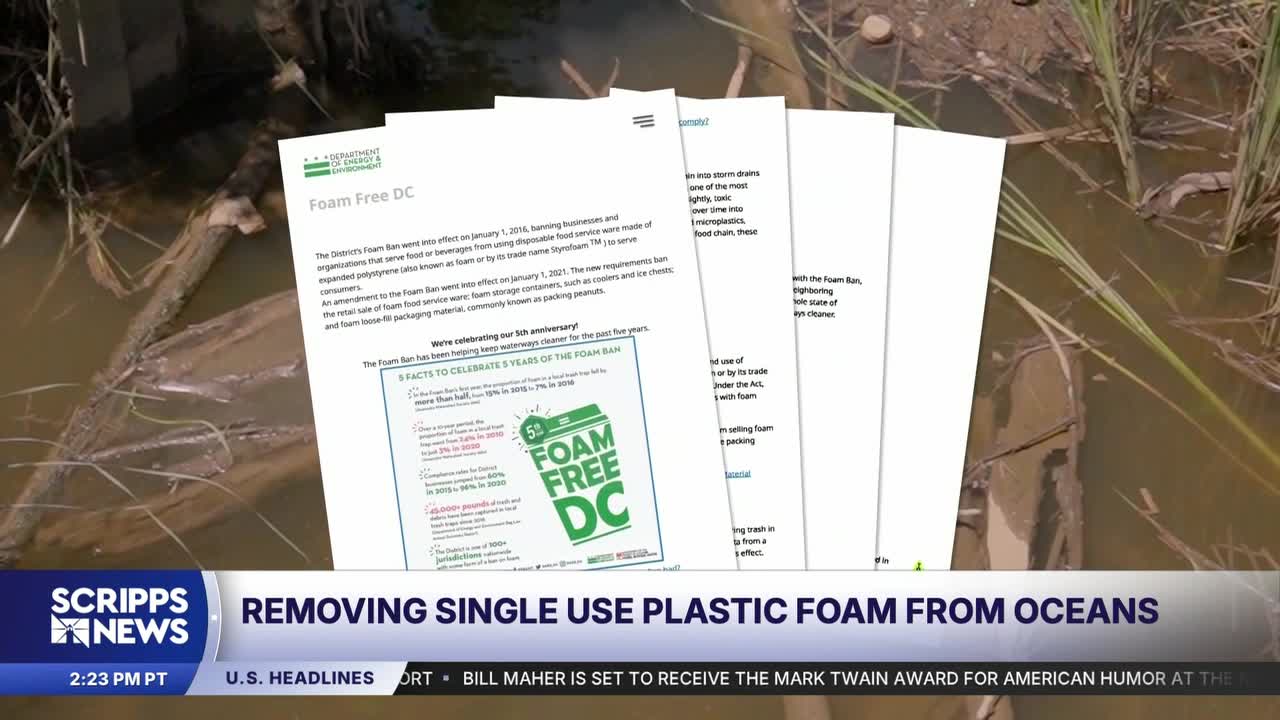
Twelve states and over 250 counties and cities have passed legislation banning plastic foam in food ware. Washington, D.C. is one of those jurisdictions, and its laws go even further, also banning disposable coolers and packing peanuts.
We took a walk down to the banks of the Anacostia River in Washington D.C. to see what type of plastic pollution was floating in the water. While we found numerous plastic water bottles and soda bottles, we didn’t see a lot of plastic foam.
“If we had been here a little bit more than 10 years ago, we would have seen a lot more plastic foam. So, the good news is not only did D.C. put in place a policy, but so too did Montgomery County, Maryland, and Prince George's County, Maryland, which are all the jurisdictions that have tributaries that flow into the Anacostia River, so those all went into effect during 2016 and that means that the river got a lot cleaner,” Leavitt explained.
In 2021, the Virginia legislature passed a plastic foam ban for restaurants, and it goes into full effect on July 1.
But one key question as more plastic foams bans are announced — if not plastic foam, then what?
Leavitt says the best choice is reusable and refillable options. “We need to move from the single-use plastics into more system wide change that relies on reusable products, refillable products, and that is for restaurants moving from that single-use plastic foam to having a cup that you could reuse,” she said.
There is an upfront cost for restaurants and businesses that need to switch to more environmentally friendly products, but studies have shown those increased costs can be minimal, and the change can even bring savings down the line.
There are Democratic-led bills in Congress aiming to ban single-use plastic foam in food ware, disposable coolers, and in packing peanuts, but it's unclear if that effort is going to get any traction on Capitol Hill this year.
