

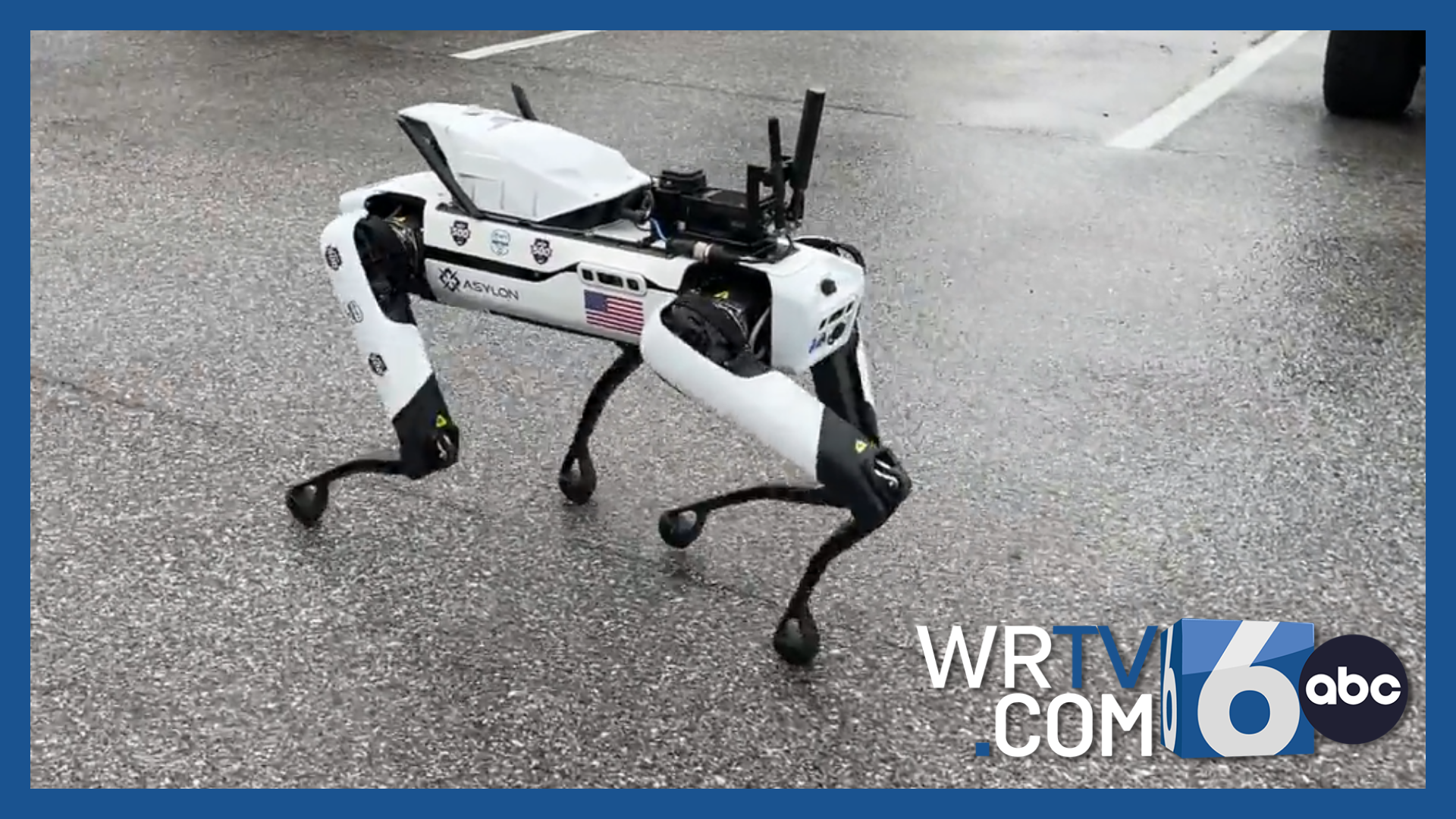


INDIANAPOLIS (WRTV) — A tech startup co-founder on Wednesday said his company’s robotic security dog adds another layer to security at the world’s largest single-day sporting event.
Brent McLaughlin said his company, Asylon Robotics, started out 11 years ago working on aerial drones for the Air Force. After some initial success, McLaughlin said the Air Force asked his company to help them work out some problems they were having with a robotic security dog.
The result was DroneDog. In 2024, he said a mutual contact said Indianapolis Motor Speedway‘s security team was looking for new security solutions and asked if he might be able to help.
“They were looking for creative solutions, specifically, this past year, doing tunnel security,” he said. “You can deploy a robot into a situation and get eyes on, get situational awareness, and then, if you need to, you can deploy humans but they can be more prepared."
This Sunday will be the third time DroneDog will help with security on race day. McLaughlin said the remote-controlled pooch has operated in the IMS tunnels in previous years. He said race day’s vast crowds, coupled with IMS’ complex infrastructure, make it a good proving ground for the technology.
McLaughlin said lessons learned from previous years led him to partner with another company to develop a mesh radio system for DroneDog. Mesh radio systems are decentralized networks that allow signals to get out in challenging conditions.
“This is actually one of our first tunnel deployments that Asylon has ever conducted,” he said. “You have so many people, hundreds of thousands of people. Traditionally, we’ve used LTE and other commercial communications systems. You can’t do that when you have such a large nexus of people.”
DroneDog has surveillance and thermal scan capabilities. McLaughlin said it can also be equipped with chemical-detection technology or two-way communications if needed. He said DroneDog will be operated remotely from his company’s Philadelphia headquarters. It will work without the aid of a human handler.
McLaughlin said acts of mass violence at public events have underscored the need for new security solutions. He said no single option is perfect, but he hopes DroneDog provides another layer on race day.
He said some of the best moments come simply from being able to interact with the public.
“Some people can be put off a little by the technology. It’s new. It can be a little scary. You know, science fiction movies tend to portray these in a negative way,” he said. “But once they get a moment to see the system, to interact with it, to ask questions and understand the value that it brings.”
