

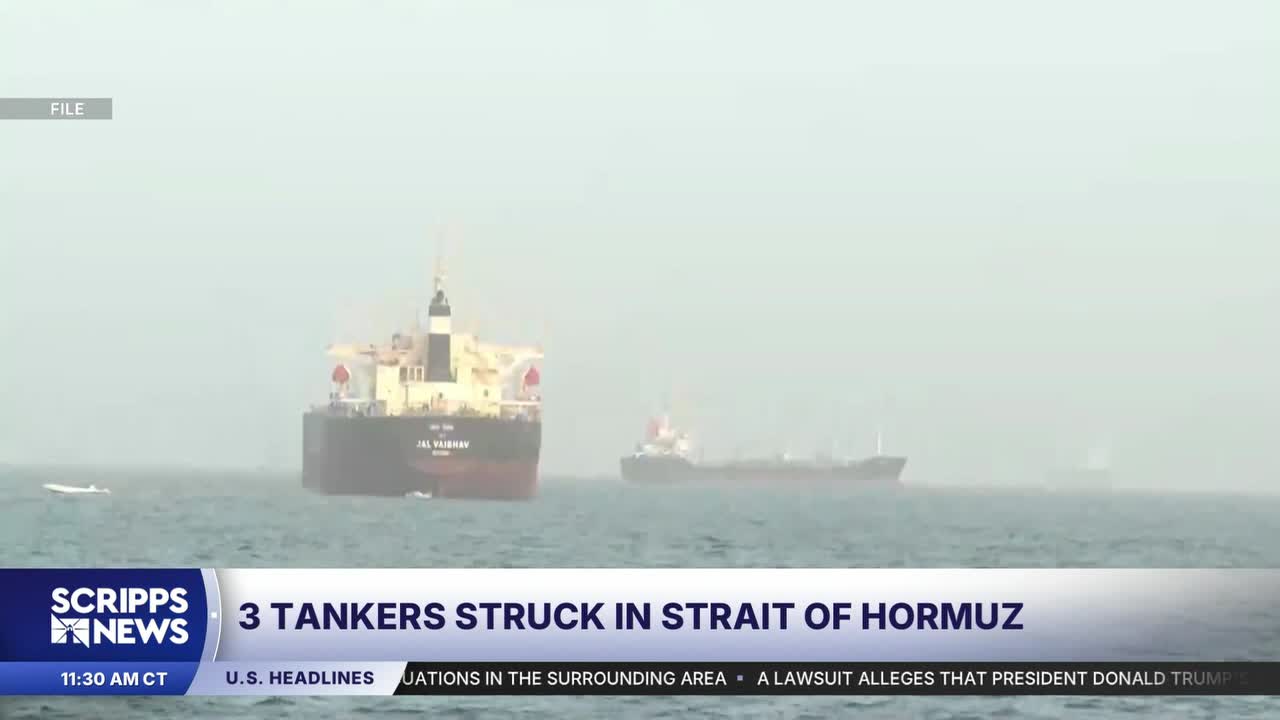


Iran fired on three commercial vessels Tuesday in Oman’s territorial waters near the Strait of Hormuz, according to a US official.
The official described the strikes as a “gross violation” of the memorandum of understanding with Iran. The third strike had not previously been reported. The US has a broad range of potential responses to the alleged violations and is considering all of them, according to the official.
The Qatari-flagged vessel al-Rakiyat, a liquefied natural gas tanker, was “passing near” the key waterway when it was struck, Qatar’s Foreign Ministry said Tuesday. The UK Maritime Trade Operations (UKMTO) center said the attack was reported at 9:19 p.m. UTC on Monday, which was 1:19 a.m. Tuesday in the Persian Gulf.
RELATED STORY | Iran warns oil tankers to use approved routes in Strait of Hormuz or face a 'forceful response'
The attack occurred hours before US President Donald Trump departed for a high-stakes NATO summit in Ankara, Turkey, where leaders are expected to discuss security in the strait, and as Iran observes a multi-day funeral for its slain supreme leader, Ayatollah Ali Khamenei.
The Qatari Foreign Ministry blamed Iran, condemning the attack as a “grave and explicit violation of international law” in a statement Tuesday. It called on Tehran to “immediately halt all practices that affect the security of the region or threaten the safety of international navigation.”
“We hold (Iran) fully legally responsible for this attack and any resulting damage or repercussions,” the ministry added.
Iran’s semi-official Fars News Agency, citing claims from unidentified sources, earlier reported that a Qatari tanker was attacked while passing through the Strait of Hormuz “after ignoring repeated warnings.”
“No official authority has yet confirmed or denied these reports,” it added.
IN CASE YOU MISSED IT | Iran's uranium enrichment explained: What's at stake in US-Iran nuclear talks
The UKMTO, Britain’s maritime security monitor, said the vessel was eight nautical miles east of Limah, Oman, when it was reportedly struck on its port side, igniting a fire. No casualties or environmental impact have been reported, it added.
Tehran has paused fragile negotiations with the US aimed at reaching a lasting deal to end their conflict during the multi-day funeral for Khamenei, who was killed in an airstrike on February 28, the first day of the US-Israeli war with Iran.
On Monday, Trump told reporters that the US would either reach a deal with Iran or “finish the job,” according to Reuters.
In a post to X on Tuesday alongside photos of crowds of mourners honoring Khamenei, Iranian Foreign Minister Abbas Araghchi warned that negotiations on a final deal “will not commence if threats continue.”
He invoked paragraph 13 of the US-Iran memorandum of understanding, which says the two sides must fulfill several conditions before they can start negotiating a final deal.
Among those conditions is an end to all fighting, including in Lebanon, where Israel’s military carried out several strikes Monday, according to reports in Lebanese state media.
Another condition is that Iran use its best efforts to ensure safe, free passage for commercial vessels through the Strait of Hormuz.
Iran’s bargaining chip
Authorities in Iran have repeatedly used the Strait of Hormuz — through which around a fifth of the world’s crude flowed before the war — as a bargaining chip.
Since the memorandum of understanding was signed, an increased number of ships have transited the Strait of Hormuz — many of those following a route that passes close to Oman, which shares the waterway.
Tehran, meanwhile, has tried to strengthen its leverage by saying crew members must gain permission to traverse the strait along routes approved by its officials.
On Sunday, Iran’s Islamic Revolutionary Guard Corps (IRGC) warned that its navy deployed patrol boats to block the “Omani route,” Iranian media and a Telegram channel affiliated with the IRGC said. In its report on the alleged attack, Iran’s Fars News Agency cited its sources as claiming the tanker had been attempting to transit the “Omani route.”
Traffic through the strait had remained steady in recent days but was not increasing, according to a post from the UKMTO on Sunday, which warned that risks remain for vessels crossing the crucial waterway.
“Risk remains lower than during the pre-MOU period; however, Iranian intent and capability to conduct intentional hostile action remain, and the environment continues to warrant heightened vigilance despite the absence of recent escalation,” the post from the UKMTO said, referring to the US-Iran memorandum of understanding.
One hundred and eight boats crossed the strait from Friday through Sunday, according to a Monday update from maritime tracking agency MarineTraffic. Before the war, more than 100 vessels transited the strait each day on average.
The-CNN-Wire™ & © 2026 Cable News Network, Inc., a Warner Bros. Discovery Company. All rights reserved.
