

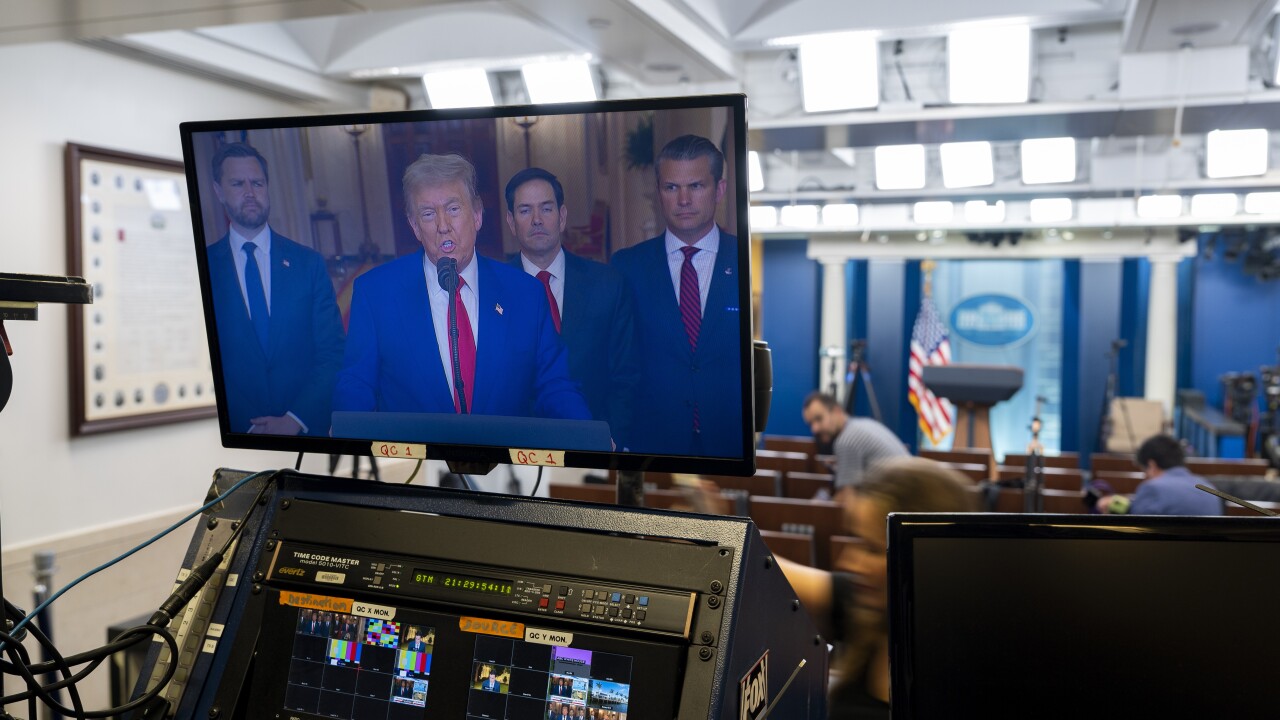


President Trump warned if no nuclear deal is reached with Iran it will be “very traumatic” for them.
Trump said his timeline for Iran was “over the next month, something like that.”
It comes as Trump appears to up pressure on Iran, while balancing negotiations with retaining the potential for military options.
“We have to make a deal, otherwise it's going to be very traumatic. Very traumatic. I don't want that to happen, but we have to make a deal. They should have made a deal the first time, and they got Midnight Hammer instead. And this will be very traumatic for Iran. If they don't make a deal, look if they don't make a deal, then it will be a different story,” Trump said.
Trump earlier in the day suggested a second aircraft carrier strike group was ordered to prepare to deploy to the Middle East, sharing an exclusive Wall Street Journal article published Wednesday on the move on Truth Social, that also cautioned the president hadn’t given an official order. Trump told Axios in an interview he was considering sending a second carrier to the region earlier in the week.
RELATED STORY | Trump presses Iran on nuclear negotiations after White House meeting with Netanyahu
Sending a second carrier strike group is seen as a way to add pressure on the Iranian regime amidst negotiations, according to former defense officials.
“That’s a big deal,” said one former official, who also noted they do not believe the administration is preparing to strike, “I think the moment has passed.”
“What he’s trying to do is put continued pressure on Iran during negotiations,” the former official said.
But another former defense official added they “don’t think it’s a bluff,” noting they believe it’s pressure on the Iranians but retaining options if negotiations don’t go well.
“My feeling is the United States should go in and address the military targets in Iran, primarily if there's any air defense they're building up, which I thought we should have really kept an eye on, also their ballistic missile production capability and any ballistic missile capability they'd go after, because that's the threat to mainly Israel, but also us, the United States, forces in the region and our GCC partners, and also command and control,” the former official previously said.
The US already sent the USS Abraham Lincoln to the Middle East, as President Trump previously warned of an “armada” sent to the region. At the time, the president wanted to retain optionality, according to a source familiar with the administration’s thinking.
But the president has publicly suggested his preference is for diplomacy, including after a meeting with Israeli Prime Minister Benjamin Netanyahu at the White House Wednesday.
“We had a very good meeting yesterday with Bibi Netanyahu, and he understands. But it's ultimately up to me. If the deal isn't a very fair deal and a very good deal with Iran, then it's going to be, I think, a very difficult time for them,” Trump said.
“There was nothing definitive reached other than I insisted that negotiations with Iran continue to see whether or not a Deal can be consummated. If it can, I let the Prime Minister know that will be a preference. If it cannot, we will just have to see what the outcome will be,” Trump wrote on Truth Social afterwards, while also urging Iran to be “more reasonable and responsible.”
Netanyahu has shared distrust of Iranian promises with US officials, and said he shared his skepticism during the leaders meeting.
“The president thinks that the Iranians have already learned who they are dealing with. He thinks that the conditions he is creating, combined with the fact that they surely understand they made a mistake the last time when they did not make an agreement, could create the conditions for achieving a good agreement,” Netanyahu later said.
“I will not hide from you that I expressed general skepticism regarding the nature of any agreement with Iran. But I said that if indeed an agreement is reached, then it must include the elements that are very important from our perspective, from Israel’s perspective, and in my view not only Israel’s. It is not only the nuclear issue; it is also the ballistic missiles and also the Iranian proxies. With that, the conversation was exhausted, I would say, although it of course also touched on Gaza and on the entire region and other general matters,” the prime minister told reporters.
RELATED STORY | Iran expresses cautious optimism after nuclear talks with US
Israel has pushed for discussions to include Iran’s ballistic missile program and support for proxy groups, which Iran has not publicly indicated an openness to.
One former defense official said they think “Israel would be very happy if we struck Iran for them.”
“I think what the Israelis are worried about is that it'll be something symbolic, or worse yet, that it'll be something that's delayed until it becomes sort of a non issue anymore, because the Iranians are going to keep dragging things along at the negotiating table. So I think what the Israelis are actually looking for is, they're looking for a sort of reassurance that their green light to deal with the Iranian ballistic missile program is still a green light if they feel like they need to do it,” said Ilan Berman, senior vice president of the American Foreign Policy Council.
Trump said he thought a deal could be reached following talks between US and Iranian officials last week, though Iran’s foreign minister told Al Jazeera it only included discussion on Iran’s nuclear program and that the “matter of zero enrichment is, from our perspective, completely outside the scope of the talks.”
“For us it was a way to measure the seriousness of the other side, and to find out how we could continue the process. Therefore we mostly addressed the generalities. Our principles are clear. Our demand is to secure the interests of the Iranian nation based on international norms and the Non-Proliferation Treaty and peaceful use of nuclear energy. So as for the details we should wait for the next steps and see how this diplomatic process will continue,” said Esmail Baghei, a spokesperson for Iran’s Foreign Ministry, at a press conference Tuesday.
Ahead of the indirect talks, a senior administration official described a good faith effort by the US to reach a conclusion, reiterating that the administration wants to see no weapons enrichment, but that the president always retains every option.
