


INDIANAPOLIS — If you enjoy celestial events, be sure to look up at the night sky Friday and Saturday.
WATCH FULL STORY BELOW
"We have a planetary parade," explained Dr. Aarran Shaw, director of the Holcomb Observatory and Planetarium at Butler University. "Six planets are going to be lined up in the night sky, just after sunset."
"This is going to kind of peak on Saturday, the 28 of February, but all of the planets are visible right now," Dr. Shaw continued.

Friday evening skies should be clear in Central Indiana, which is great for viewing the sky. Saturday evening may be a bit cloudier.
Wondering how to see all the planets?
Start by finding the moon in the east. Jupiter will be nearby.
"The crown jewel is really Jupiter," said Dr. Shaw. "Jupiter's really easy to see with the naked eye. If you do have access to a pair of binoculars or a telescope, you can take a look at Jupiter. See some of its moons."

To the west, you'll see Saturn, Mercury and Venus, but don't wait too long to find them.
"They will disappear pretty quickly after sunset," shared Dr. Shaw. "You need to be quick on that."
If you have a telescope, you may also see faraway Neptune.
"You might even be able to catch Uranus quite high in the night sky as well," said Dr. Shaw.
If you don't have a telescope and want to see things more clearly, the Observatory will be open to the public both Friday and Saturday night.

"I just like that it gets people out and looking at the planets, right? There's nothing like looking at a different world," Dr. Shaw said.
While the planetary parade is not very rare (in fact, we had one in January 2025), there is another event on the horizon.
"We have a total lunar eclipse happening on Tuesday morning," continued Dr. Shaw.
This event is not as rare as the solar eclipse that Central Indiana experienced in April 2024.
"This is when the full moon passes through the earth's shadow," explained Dr. Shaw. "This turns the moon kind of blood red."
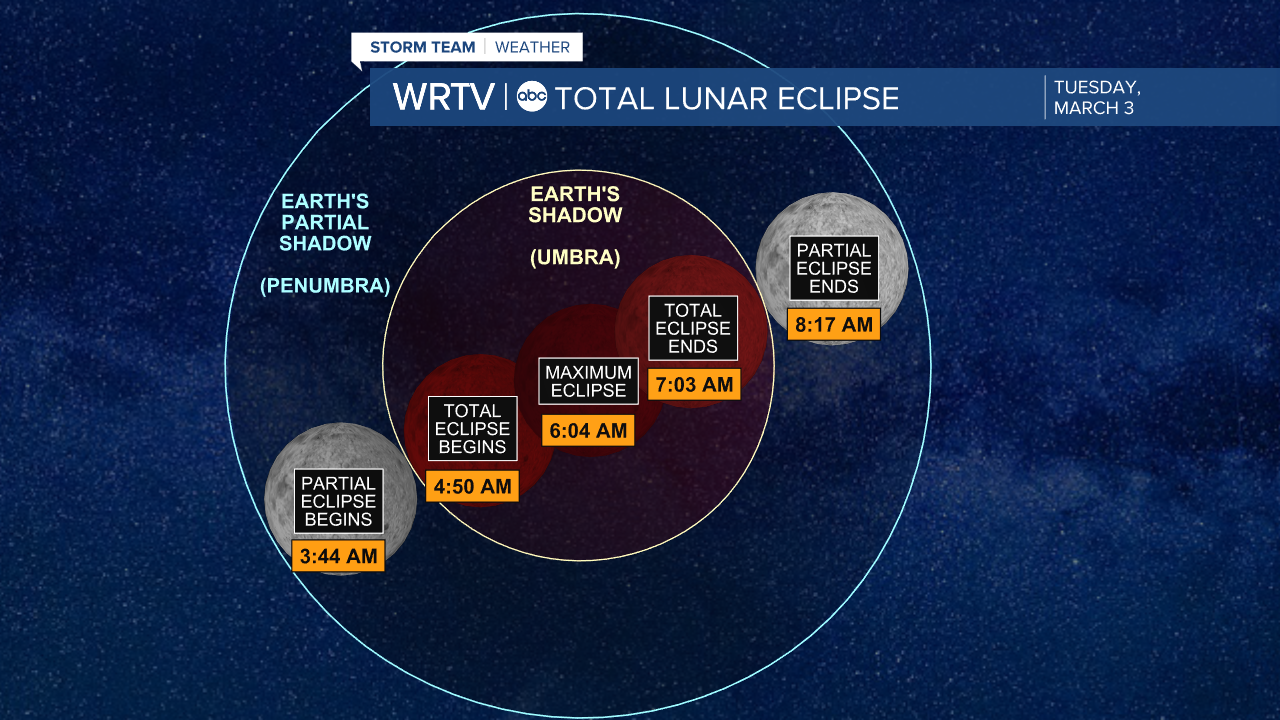
The eclipse happens in the early morning hours on Tuesday, before sunrise, with the maximum eclipse around 6 a.m.
"It's really exciting, and we won't see one of these for a good while, a good few years now," said Dr. Shaw.
__
