

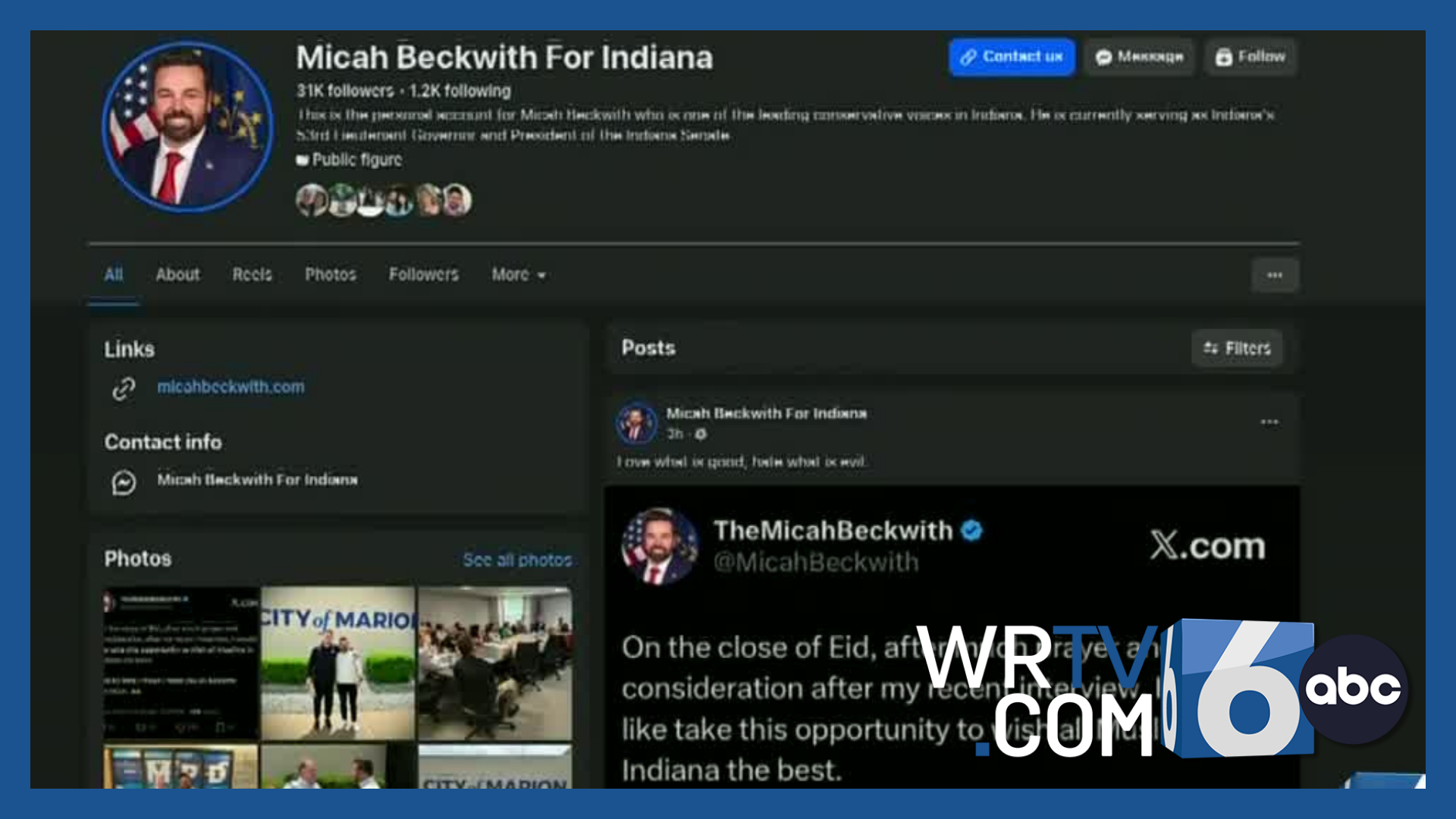


Indiana Lt. Gov. Micah Beckwith is facing criticism over his comments on Islam in a recent online interview and in follow-up comments on social media.
The comments have drawn criticism from faith leaders, elected officials, and members of the Muslim community, with some questioning the impact that rhetoric like this can have across Indiana.
"I said what I mean, and I mean what I say. I have no love for Islam. Now, I love Muslims, every single Muslim. I have a big heart for, and I certainly would give them the shirt off my back, but their ideology is incompatible with who we are as Americans."
The Republican lieutenant governor talked Friday with WRTV to defend comments he made during a May 21 interview on a platform called FlashPoint, where he described Islam as a "demonic death cult" and said he hates Islam.
His comments quickly sparked criticism from faith leaders, community organizations, and elected officials, including U.S. Rep. André Carson, an Indiana Democrat who is Muslim.
Carson issued a statement.
"These remarks are outrageous, dangerous, and completely unacceptable from a public official. This rhetoric is hateful and targets an entire faith community, including countless Muslim Hoosiers who contribute to our state every single day as teachers, doctors, first responders, and small business owners. Hoosier Muslims and the billions of Muslims around the world deserve the same dignity and respect as anyone else. Leaders of both parties should unequivocally condemn these comments and reject hate in all its forms."
In response to the statement, Beckwith said Carson "needs Jesus."
Beckwith said, "André Carson, you need to really do some soul searching and say, 'Is this really the path of goodness that I want to walk?' I would say it's not, and by the way André, Jesus has his arms wide open, and he will accept you the moment you surrender to him, and I think it will be the best thing you've ever done in your life."
Muslim faith leaders say comments such as Beckwith's can deepen divisions and fuel harmful stereotypes, especially after Muslims were targeted and killed May 18 at a mosque in San Diego.
Yaqoub Saadah, community engagement coordinator of the Indiana Muslim Advocacy Network, said, "To have our lieutenant governor in Indiana making those comments following that tragedy, it does not make me as a Muslim Hoosier feel any safer, and I feel like it contributes to the growing anti-Muslim climate that leads to the dehumanization to Muslims, and it ultimately leads to tragedies that we saw in San Diego."
CEO Azhar Azeez of the Islamic Society of North America said, "This rhetoric is very hateful. This kind of rhetoric creates a lot of challenges for our communities, especially for women who are dressed in certain attire using hijab."
The controversy continued Thursday after Beckwith posted on social media, marking the end of Eid — two major festivals celebrated by Muslims worldwide — by saying he wished Muslims in Indiana "the best" before adding, "and by best I mean I hope you all become Christian."
Beckwith said in his News 8 interview, "God has something better for the Muslim community, and it's going to be found in Christ, and Christ alone."
Not all Christian leaders share Beckwith's belief.
The Rev. Bradley Pace, rector of Trinity Episcopal Church in Indianapolis, says what Beckwith is saying isn't Christian-like, as Christianity shares its origins with both Islam and Judaism. "We are siblings in the truest sense, so his words, to me, they sound like a threat, and I fear are likely to encourage more violence. We're called to convert through love, not through threats, not through intimidations."
Beckwith, who is also a campus pastor at Life Church in Noblesville, said in the interview that his comments stem from his Christian beliefs. "For those who say we shouldn't hate, that is the dumbest thing any culture could ever buy into. We absolutely should hate. We should hate evil. I don't want evil coming into my culture, I don't want anything to do with something that could destroy Hoosier families across this state."
People in the Muslim community say they hope the comments can open a positive and broader conversation about religious differences and acceptance across communities.
Saadah said, "Get to know your neighbors, connect with people that you don't know who have differences, and don't let the differences that you have divide you."
The full interview with Beckwith is posted on the WRTV YouTube page.
