


BLOOMINGTON — Do you use a space heater to stay warm? The Indiana University Office of Sustainability hopes you'll consider a swap.
The school's Space Heater Exchange Program allows faculty and staff to trade in space heaters for the choice of a heated blanket, heated seat pad, heated foot pad, or a flannel blanket.
So far this winter, 96 space heaters have been traded. Why is this the focus?
WATCH FULL STORY BELOW
"With these four options, you're putting the heat directly onto the person instead of the air, so it's a more efficient way for you to get warmer," said Jessica Davis, Associate Vice President for Sustainability with Indiana University.
Davis went on to explain how these swaps have saved energy around Indiana University's campuses.
"If you happen to be in a location that's near the building's thermostat, the building may start reading that your space is hotter than it truly is," Davis continued. "You're kind of creating an artificial environment; the building may actually start cooling down your space."
Stacy Lozer is the Director of Career Services for the O'Neill School of Public and Environmental Affairs.
Lozer recently took advantage of the trade-in program.
"We had this really unique and amazing opportunity to take those old space heaters that eat up a lot of energy, that quite often smell and aren't as effective, and trade them in for a nice warm fuzzy blanket," Lozer said, while covering up with her new heated blanket. "In my office, I have a lot of windows. It's a great way to stay warm and just not waste kind of that space heater air that's just circulating around."
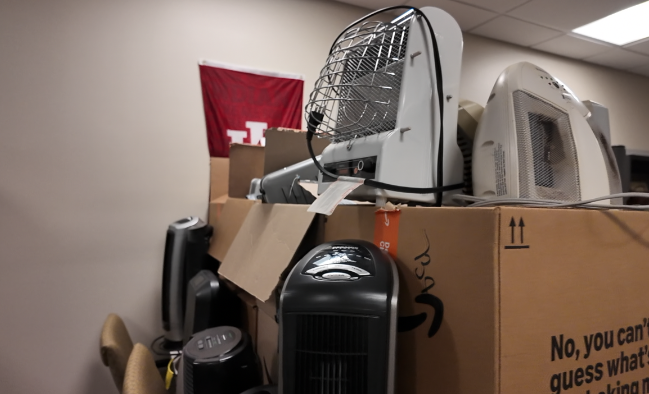
The 96 space heaters that have been traded in (including Lozer's) will save energy and money for the university.
"About 48,000 kilowatt hours of energy a year, and that's about $12,000 worth of financial savings," Davis stated.
"If you make little changes, it makes a huge difference," said Lozer.
The Office of Sustainability works with Circle City Mutual Aid to find new off-campus homes for the space heaters traded in during this initiative.
While the exchange program is only offered to those at IU, Davis hopes the public will consider switching their own space heaters for greener alternatives, similar to the ones offered in the campus program.
"The same learnings here at IU can apply at home as well," Davis said.
If a space heater makes the most sense to use to keep your space warm, make sure you use it safely.
"Only use space heaters when you're in the room," says Tim Griffin with the Carmel Fire Department. "Don't leave the house. Don't leave it plugged in, and if you are going to have it plugged in, have it plugged directly to the wall. Don't use an extension cord."
Griffin went on to say that extension cords can use too much power with a space heater, and cause it to overheat.
"Make sure that it's three feet away from anything," Griffin continued.

Keeping the space heater in an open area on top of stable ground could prevent you, your pets, and your kids from knocking the space heater over, which could start a fire.
"I know we're talking about the extreme temperatures, but if something does happen because of the extreme cold, those working smoke detectors are going to make a difference in early detection, so we can get there and stop that fire before it spreads," Griffin said.
What else would Griffin avoid to keep warm?
"Leaving your stove on," Griffin said. "Having it open like that, if you have any small children, again, pets, animals that could burn themselves, you know, it's never a good idea to try to heat the house with the stove."
"If you've got a blanket or clothes, shove them in the base of your door, shove them around your window," Davis recommended. "Hopefully, we just try to make it through this, these couple of weeks that are really cold."
___
