




INDIANAPOLIS— A new survey shows 95% of insured Americans still worry about hospital bills.
The analysis by JG Wentworth also found $4,354 is the average breaking point for most people, meaning that’s the moment where a medical bill would create financial hardship.
Medical debt is a problem WRTV Investigates has been tracking for months.
“The bills roll in as fast as the treatments do,” said Norm Banister, an Indianapolis man battling Stage 4 colon cancer since 2023.
Banister is on disability because of his cancer.
“It’s very stressful,” said Banister.

Even with Medicare and supplemental insurance, he still has to pay for medical bills.
“My thoughts are, after the treatment and medication, am I going to have enough money to cover this? It works on you and makes you think a lot,” said Banister.
He’s not alone.
Americans owe a total of $220 billion in medical debt, according to the national nonprofit KFF.
A new study from Johns Hopkins Bloomberg School of Public Health shows 24% of adults with healthcare debt experienced housing instability the following year, compared with just 6% of people with no medical debt.
A national nonprofit, Dollar For, is helping people greatly reduce their medical bills.
“You can put in your household size, your income, what hospital, and it will tell you if you're eligible,” said Jared Walker, founder at Dollar For. “From there, we've created digital applications for every hospital, so you can fill it out on your phone, tablet, computer, and we submit it to the hospital for you.”
Dollar For works with hospital charity care and financial assistance to help reduce your bills.
Many people think they do not qualify.
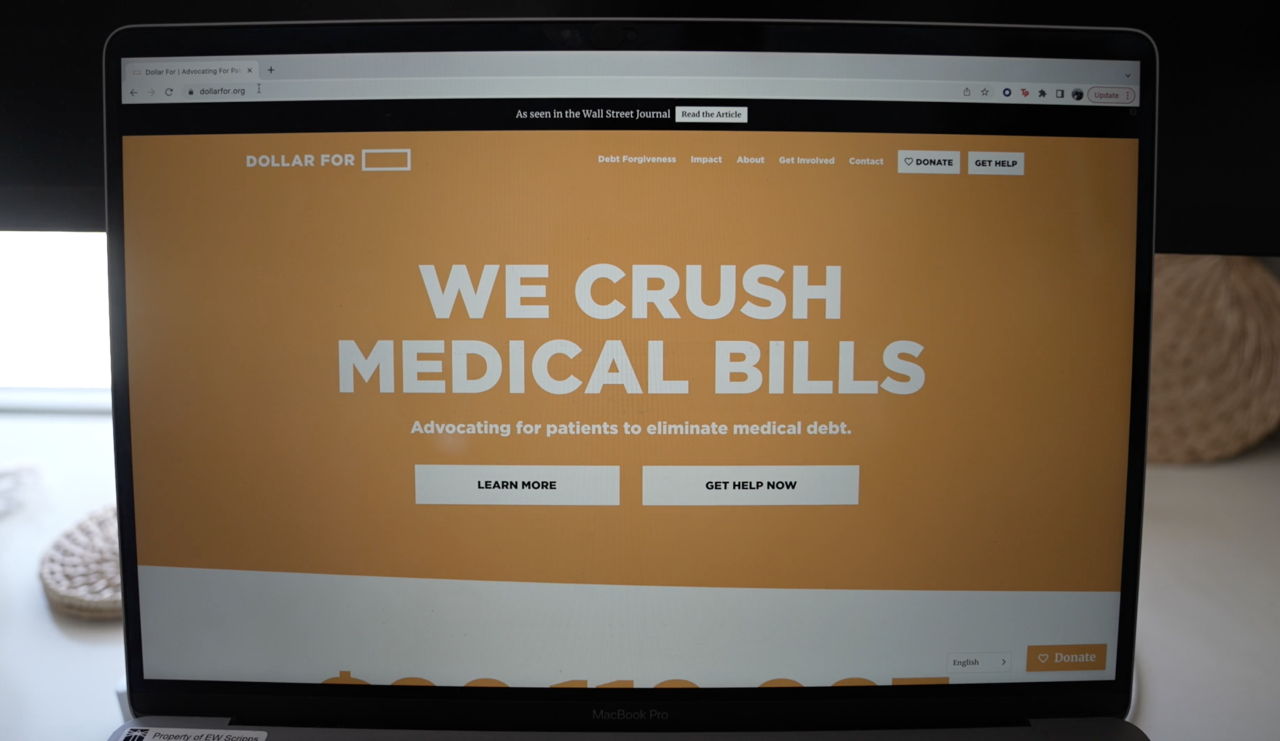
“What we found is that on average, if you are a family of four making under $100,000 gross annual income, you are eligible for something which is much more generous than people think, right?” said Walker. “There's no shame in this, like a lot of times, people are afraid to ask for help, or they don't want to ask for help. This has everything to do with a bad system, nothing to do with some personal failure on your part.”
Banister used Dollar For to whittle a $4,000 medical bill down to just $400.
“It’s a simple process,” said Banister. “You just fill out a few questions. They come back relatively quick.”
He says he can now focus more on his treatment rather than the bills.
Statement from Scott B. Tittle - President of Indiana Hospital Association (IHA)
“Indiana hospitals are listening and responding to the needs of Hoosier patients. Multiple national reports and state-commissioned studies have shown the consistent progress of hospitals to make care more affordable for every Hoosier, regardless of their ability to pay.
"While Indiana hospitals offer payment plans to help patients avoid medical debt, IHA was proud to work with Gov. Braun and legislators this session to ensure consistent communication on the financial assistance options available to every Hoosier. As our member hospitals continue to provide financial relief for patients and families, IHA remains committed to finding meaningful solutions that make care both accessible and affordable for Hoosiers.”
BELOW IS INFORMATION SHARED BY THE INDIANA HOSPITAL ASSOCIATION
Facts About Indiana Hospitals and Charity Care
- On an annual basis, Indiana hospitals provide about $1.8 billion in free and discounted care statewide to ensure every patient who walks through their doors gets the appropriate care they need, regardless of their ability to pay for it.
- According to a recent report from Kaufman Hall [ihaconnect.org], hospitals in Indiana provide more charity care to patients than the national average, demonstrating a strong commitment to ensuring patients can access needed services regardless of their ability to pay, including offering robust payment plans for patients who enroll in them.
Facts About Insurance Coverage Contributing to Medical Debt
- A few trends in health insurance are driving an increase in medical debt in Indiana: lack of or inadequate health insurance coverage; a high prevalence of self-insured health plans, which contribute to higher prices for employers; and an increasing amount of high-deductible health plans that push more costs onto patients.
- While certain types of health insurance plans may appeal to consumers because they appear to be more affordable, they often come with significantly higher out-of-pocket costs and fewer benefits. In many instances, patients can find themselves responsible for their entire medical bill without any help from their insurance company, which can leave them vulnerable to significant medical debt.
Facts About Indiana Hospitals and Progress on Health Care Affordability
Report: Indiana’s Hospital Systems Lowered Prices in 2024 [ihaconnect.org]
- A new state‑commissioned analysis shows Indiana’s five largest nonprofit hospital systems reduced their commercial prices by nearly 7 percentage points on average in 2024 compared to the year before.
- This marks one of the most significant year‑over‑year improvements to-date in the effort to make healthcare more affordable for Hoosiers.
- Commercial prices for all 5 systems averaged 252% of Medicare in 2024—a full 33 percentage points below the state benchmark set by the Indiana General Assembly.
- Indiana ranked 8th best in the nation for health care costs in 2025, up from 15th in 2021, per WalletHub.
- A 2024 Forbes analysis ranked Indiana 24th out of 50 states in health care costs — improving 13 spots from the prior year.
- Employer-based insurance premiums in Indiana have remained at or below the national average since 2020, according to KFF.
- RAND Corporation studies show a clear downward trend in Indiana hospital prices, moving from the most expensive state in RAND 2.0 (2019) to ninth in the RAND 5.1 report (2024). While IHA has raised concerns about RAND’s methodology, the RAND study has reflected Indiana’s consistent improvement across reports, pointing to meaningful progress.
- All five of Indiana’s largest nonprofit systems had prices under the state benchmark of 260% of Medicare in 2025, according to the State’s report
- IHA Statement on Direct to Employer Arrangements [my.ihaconnect.org]
- DTE examples: Indiana Hospital Direct-to-Employer Market Solutions Fact Sheet [my.ihaconnect.org]
Facts on Medical Debt in Indiana
According to the Urban Institute [apps.urban.org]:
- Indiana has the 20th lowest amount of medical debt in collections, which is $1,375. In other words, residents in 31 other states have a higher amount of medical debt than they do in Indiana.
- The rate of Indiana residents with medical debt in collections has declined significantly over the past decade.
- Since 2013, the rate of Hoosier residents with medical debt in collections has decreased 73% — from 23.9% in 2013 to 6.4% in 2023, the most recent year data is available.
- Since 2013, the rate of Hoosier residents with medical debt in collections has decreased 73% — from 23.9% in 2013 to 6.4% in 2023, the most recent year data is available.
TIPS FROM CONSUMER FINANCIAL PROTECTION BUREAU
- Request a detailed list of charges
- Ask your healthcare provider or the debt collector for an itemized bill, sometimes called a “superbill.” A superbill shows each medical billing procedure code, the amount paid by your insurance, and the amount you owe. The list makes it easier to tell whether the charges are accurate.
- Negotiate the amount you owe
- Debt collectors might not tell you that medical charges can be negotiated. You can start by going back to the healthcare provider and asking for reductions. Then, you can talk to the debt collector and ask how to lower the amount you owe.
- Submit a complaint
- Debt collectors must comply with federal law. They can’t collect amounts that aren’t owed and they can’t make harassing or abusive calls. They have to follow requirements about reporting debts to consumer reporting companies. They can’t call you around the clock, and you have the right to tell them to stop contacting you. See more about your debt collection rights and protections.You can submit a complaint about a problem with a financial product or service, including debt collection, at consumerfinance.gov/complaint or by calling (855) 411-CFPB (2372).

